
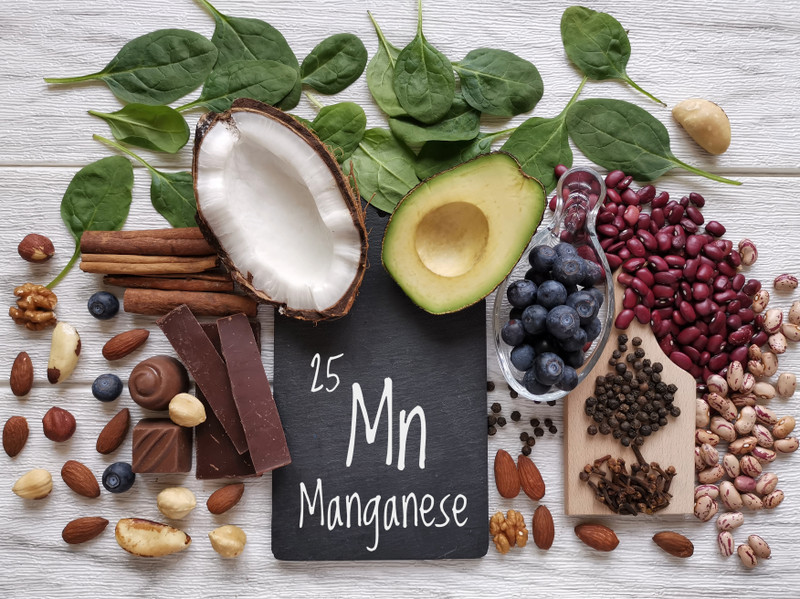
Your body’s nutritional composition includes a range of minerals. In continuing our examination of these essential minerals, here is Part IV in our installment of Essential Trace Minerals, with a look at manganese. Required only in small amounts, manganese is crucial for many enzymatic reactions as it contributes to multiple crucial aspects of physiological health.
Bodily Chemistry of Manganese
The chemical and natural traits of manganese make it comparable to iron. Like iron, manganese is abundant in earth’s crust. Both manganese and iron are also trace minerals, required in small amounts to fulfill certain nutritional and physiological roles in the human body.
Manganese functions as a coenzyme for many kinds of enzymatic reaction in the body, essentially doing the work of an enzyme by breaking down carbohydrates, proteins, and cholesterol. It also plays an assisting role to enzymes in crucial processes throughout the body, including the bones and the immune system, as well as other organs and bodily systems.
The recommended daily allowance (RDA) for manganese is minimal, at just 2.3mg for adult men and 1.8mg for adult women (but higher for women who are pregnant or breastfeeding). Deficiency is extremely uncommon as manganese is present in so many foods. Toxicity can occur from excessive manganese consumption, but the predominant causes are industrial exposure to inhaled manganese, or areas where a higher-than-accepted amount is present in public drinking water.
Reasons to Supplement with Manganese
Because deficiency is so unlikely, it is only under specific health circumstances where there is likely to be a meaningful need for manganese supplementation. In these circumstances, taking manganese could contribute to a holistic health plan. Manganese is commonly available in supplement form as a standalone supplement (manganese sulfate), or in a complex supplement alongside other crucial vitamins and minerals. Here is how a manganese supplement could help someone with:
Diabetes: Research has shown that manganese helps carry out the process of glucose metabolism, which is part of overall carbohydrate metabolism. Evidence suggests that a blood level of manganese that is deficient could be linked to increased risk of developing type II diabetes; However, an excessive manganese level could carry the same risk. Based on this, those who have or are at risk for type II diabetes could possibly benefit from strategic manganese supplementation.
Epilepsy: Research has also established a relationship between manganese deficiency and epilepsy. Those who experience epilepsy are often low in manganese. Therefore, it can be reasoned that manganese supplementation may help, if the person is indeed low in manganese.
As a trace mineral that is naturally found in many foods, manganese deficiency is one of the least likely circumstances to occur among minerals. However, attention should still be paid to manganese in the contact of nutrition. It is recommended that you always talk to your healthcare provider adding manganese, or any supplement for that matter, to your regimen.