
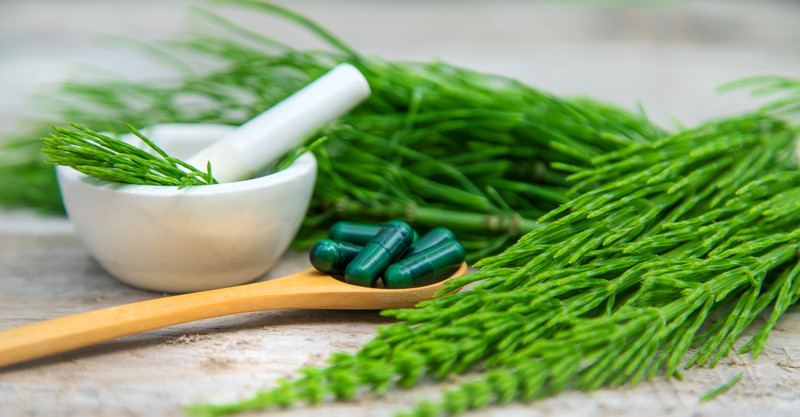
One of the joys and curiosities of learning more about natural remedies is finding health boosters that can aid and assist in improving your future health while digging deep into the past of many such products. And some of those histories date back many centuries to ancient times when keen and innovative medical practitioners early on discovered the health benefits of much of nature’s finest growing all around them.
Such is the case with horsetail, which is our latest entry into our ongoing series of lesser-known – hence, the term “unsung” – supplements that have been around for hundreds of years, in horsetail’s case dating back to the Greek and Roman empires. In earlier blogs in this series, we typically offered a brief roundup of each of multiple natural remedies. But we came to believe we were having to leave out more detailed “bonus” information for each product for the sake of brevity. That is why we have since switched to focusing on one “unsung” supplement at a time in each blog, in a sense “digging deeper” on lesser-known products that we believe are of unique interest to our readers.
Okay, Does Horsetail Come from Horses?
This might shock you (actually, it shouldn’t), but the answer is no. Horsetail is a perennial fern found growing wild in moist environments of temperate climates, mostly in locales such as northern Europe and North and Central America. It is a plant that bears a variety of beneficial compounds with health-bolstering properties, to include – but not limited to -- antioxidants and silica.
If you often read blogs posted on this website, you probably have found that many products share status as an antioxidant, consisting of molecules that guard your body from the damage-causing effects (to your cells) of free radicals that roam your body with ill intent. However, the mention of “silica” as a component of horsetail is something you see rarely linked to other herbs or supplements. Silica is a compound composed of silicon and oxygen, which together provide health benefits for your skin, nails, hair, and bones. In other words, right out of the gate, horsetail covers a wide gamut of means to possibly enhance your health.
Let’s look at several of horsetail’s specific health benefits:
5 of Horsetail’s More Notable Health Benefits
Heals wounds/relieves burns. Horsetail’s provision of silica has been identified as an apparent link to the synthesis of collagen, an important building block in the strength and elasticity of your skin. Hence, horsetail’s reputation for helping to repair damaged skin.
Treat incontinence. Limited research has already shown that horsetail is believed able to tone the bladder wall and diminish inflammation, thus contributing to the alleviation of incontinence and frequent urination.
Bolster hair strength and growth. This is one of the areas in which silica and horsetail’s antioxidants work in tandem, helping to enhance hair fiber strength and reduce breakage. Silica’s role focuses on the structural integrity of hair shafts, possibly helping to produce thicker, more hardy hair.
Treatment of edema. In pill form at least. Horsetail has demonstrated a diuretic effect associated with the improvement of a peripheral edema. In fact, such a diuretic effect has drawn comparisons in terms of effectiveness to hydrochlorothiazide, a well-known conventional prescription medication, while yet accomplishing this without significant changes to your liver or kidney function.
Regulate blood-sugar levels. This preliminary belief is based on emerging evidence that shows horsetail extracts can help reduce elevated blood-glucose levels and perhaps even support pancreatic function, giving promise for the support of metabolic health. Added research is ongoing.
Maybe you have never heard of horsetail before, but based on what you read above, you can see it is truly a time-tested perennial herb with a variety of purported health benefits. Keep in mind, if you are considering adding it to your daily regimen, even for the short term, be sure to discuss its use with your personal physician or other healthcare practitioner. Note, too, that in some of the products associated with horsetail, it makes up only a small percentage of all constituents included in a particular product. Be sure to read the labels carefully.